October 23, 1941: The Lend-Lease Act
The day the Senate passed a $5.98 billion supplemental Lend-Lease appropriation
What happened on October 23
On October 23, 1941, the U.S. Senate passed H.R. 5788, a bill “to make supplemental lease-lend appropriations” of about $5.98 billion. The Library of Congress notes that it brought the total aid available under Lend-Lease to nearly $13 billion and brought the United States “one step closer to direct involvement in World War II,” weeks before Pearl Harbor.
The Lend-Lease Act itself is older: it became law on March 11, 1941. October 23 marks the Senate vote on the second round of money for it.
What the Lend-Lease Act did
Officially titled “An Act to Promote the Defense of the United States,” the law let the President supply war materials to “any country whose defense the President deems vital to the defense of the United States.” Its popular name comes from its wording, which allowed the government to:
“sell, transfer title to, exchange, lease, lend, or otherwise dispose of” defense articles.
Britain could no longer pay cash for supplies under the 1939 “cash and carry” rules. Lend-Lease let the United States send ammunition, tanks, airplanes, trucks and food while staying officially neutral. Repayment did not have to be in dollars; it could be “in kind or property, or any other direct or indirect benefit.”
The program started with Great Britain and within months was extended to China and the Soviet Union. The first Lend-Lease aid to the Soviet Union was on its way by the end of October 1941. Over the course of the war the United States signed Lend-Lease agreements with more than 30 countries and supplied about $50 billion in aid.
What those amounts are worth today
Adjusted for inflation with the U.S. Consumer Price Index (CPI-U, all items, U.S. city average): 1941 annual average 14.7, September 2026 (latest available) 336.940, about 22.9 times higher.
- $7 billion first appropriation, March 1941: about $160 billion in 2026 dollars
- $5.98 billion Oct 23, 1941 supplemental: about $137 billion in 2026 dollars
- ~$13 billion total available after the vote: about $298 billion in 2026 dollars
- ~$50 billion all Lend-Lease aid, 1941–1945: about $1.1 trillion in 2026 dollars (using 1941 prices; most of it was spent later in the war, when prices were higher, so this is an upper estimate)
CPI measures consumer prices, so this is only one way to compare. Measured as a share of the much smaller 1941 U.S. economy, these sums would be far larger today.
Was it repaid?
Mostly not, by design. Lend-Lease was not a loan: the United States did not ask to be paid for weapons and supplies used up in the war. It asked only for civilian goods still on hand or in transit when the program ended in 1945, and for war surplus the Allies chose to keep. The settlements were a small fraction of the aid.
- Total aid $49.1 billion reported through December 31, 1945 (later reports bring it to about $50 billion). The British Empire received about $30.8 billion, the Soviet Union $11.1 billion, France $2.4 billion and China $1.3 billion (Lend-Lease report to Congress, 1946).
- Aid in return Allies supplied the U.S. with about $7.3 billion of “reverse lend-lease” (bases, food, fuel, shipping) through VJ Day, mostly from the British Commonwealth (same report).
- United Kingdom On December 6, 1945 the two governments settled Lend-Lease, surplus property and war claims for a net $650 million (about $12 billion in 2026 dollars), repaid on the same terms as the $3.75 billion postwar loan signed that day: 50 yearly payments at 2%, from 1951. After six deferred years, Britain made the last payments on December 29, 2006, including $83.25 million to the U.S. (U.S.-U.K. Joint Statement; BBC).
- Soviet Union After decades of deadlock, the U.S. and USSR agreed on October 18, 1972 to a settlement of $722 million (about $5.8 billion in 2026 dollars), due by 2001. Moscow paid the first $48 million, then stopped when the 1974 Trade Act denied it most-favored-nation trade status. Russia accepted the debt and agreed a new repayment schedule in 1993 (Office of the Historian; Senate Finance Committee; State Department). The Kremlin says Russia made the final Lend-Lease payments in 2006 (TASS).
- France On May 28, 1946 France agreed to pay $720 million (about $12 billion in 2026 dollars) in final settlement of Lend-Lease, surplus property and war claims, at 2% over 30 yearly payments (Office of the Historian).
2026-dollar figures use the same BLS CPI-U method as above, from the year of each agreement (1945: 18.0, 1946: 19.5, 1972: 41.8; September 2026: 336.940).
Key dates
- Sep 2, 1940 “Destroyers for Bases” deal with Britain
- Dec 17, 1940 Roosevelt proposes the idea that becomes Lend-Lease
- Jan 10, 1941 Lend-Lease bill (H.R. 1776) introduced in the House
- Mar 11, 1941 Lend-Lease Act becomes law
- Mar 27, 1941 First appropriation: Defense Aid Supplemental Appropriation Act ($7 billion)
- Jun 1941 Germany invades the Soviet Union
- Oct 23, 1941 Senate passes the $5.98 billion supplemental Lend-Lease appropriation (H.R. 5788)
- Oct 28, 1941 Executive Order 8926 creates the Office of Lend-Lease Administration
- Dec 7, 1941 Pearl Harbor; the U.S. enters the war days later
Hear and watch
Original recordings of President Roosevelt. Most are audio only (radio broadcasts); the videos are newsreel film or short films that use the original sound. Links open on the host's site.
Dec 29, 1940 “Arsenal of Democracy” fireside chat
- Audio + transcript Miller Center, University of Virginia
- Audio Original CBS broadcast recording (National Archives ID 2174675), on the Internet Archive
 Video “Arsenal of Democracy”, FDR Library short educational film with the speech audio (2:39)
Jan 6, 1941 “Four Freedoms” State of the Union
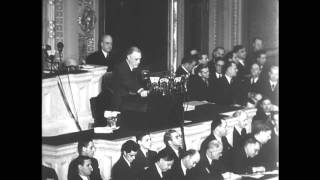 Video FDR Library: Paramount newsreel film of the speech synced with the original audio (2:37)
- Audio + transcript Miller Center, full speech
Mar 15, 1941 Address on Lend-Lease, four days after signing
- Audio + transcript Miller Center: “On Lend Lease”
 Video British Movietone: “Lend-Lease Act - 1941 | Movietone Moment”, March 1941 newsreel of Roosevelt speaking on the bill (1:51)
Oct 27, 1941 Navy and Total Defense Day address
- Audio UNT Digital Library: radio recording, part 1 of the speech
- Text American Presidency Project transcript
Today Modern explainer
More original recordings from 1940–41, including White House press conferences, are in the FDR Library's Recorded Speeches and Utterances collection.
“Lease Land” or “Lend-Lease”?
The program is often misremembered as the “Land Lease” or “Lease-Lend” Act. The correct name is Lend-Lease; it was about lending and leasing war supplies, not land. (Congress's own 1941 vote record does use “lease-lend.”) The related 1940 Destroyers for Bases deal did involve land: Britain gave the U.S. 99-year leases on bases in Newfoundland and the Caribbean.
Sources
- Library of Congress: Today in History, October 23 (The Lend-Lease Act)
- Voteview (UCLA): 77th Congress, Senate vote 79, October 23, 1941, H.R. 5788
- National Archives: Lend-Lease Act (1941), with full text
- U.S. Office of the Historian: Lend-Lease and Military Aid to the Allies
- U.S. Office of the Historian: U.S.-Soviet Alliance, 1941–1945
- American Presidency Project: Executive Order 8926, October 28, 1941
- GovInfo: Report to the 78th Congress on Lend-Lease Operations (1943)
- U.S. Bureau of Labor Statistics: CPI-U series CUUR0000SA0 (1941 annual average, September 2026)
- U.S. Bureau of Labor Statistics: CPI Inflation Calculator
- Miller Center: Presidential Speeches (audio and transcripts)
- FDR Presidential Library & Museum on YouTube
- National Archives: Voices of World War II, 1937–1945
- The National WWII Museum: Lend Lease to the Eastern Front | WWII In 2
- GovInfo: Twenty-Second Report to Congress on Lend-Lease Operations (1946), totals by country, reverse lend-lease, U.K. settlement
- BBC News: UK settles WWII debts to allies (29 December 2006)
- The Guardian: For the British Treasury, only today is the war over (29 December 2006)
- Office of the Historian: NSDM 192, Lend-Lease Negotiations with the USSR (October 18, 1972)
- U.S. Senate Finance Committee: Background Materials on the U.S.-Soviet Commercial Agreements (1973)
- U.S. State Department: War-Related Debts of Other Countries to the U.S. Government
- TASS: Russia repaid lend-lease debts to US only under Putin (April 30, 2025)
- Office of the Historian: U.S.-France settlement of May 28, 1946